

On the life, death and resurrection of Sixto Rodriguez
October 22, 2015
Way out West: the enduring appeal of Westerns
October 22, 2015
Hollywood superstar Richard Gere praised the work of street papers and called their vendors “heroes” in interview with Philadelphia street paper One Step Away.
Gere visited Philadelphia to promote his film Time Out of Mind, in which he plays a homeless man named George who lives in New York. It’s a project close to Gere’s heart, as a passionate advocate for homeless causes, a member of the New York Coalition for the Homeless, and a supporter of the street newspaper movement.
Gere and director Oren Moverman attended a private screening for nonprofits that work with homeless people in Philadelphia. In the audience was One Step Away vendor Jerry Tucker.
“I don’t give them advice; they give me advice.”
“I think these guys are the heroes, they’re the survivors,” Gere said after the screening. “Your vendors are out there, they have done something heroic. They’ve pulled themselves out of a very deep ditch and they didn’t do it by themselves.”
Gere’s sincerity and devotion to the cause was apparent as he spoke directly with Jerry.
“After one second I felt like I knew him for years,” said the vendor afterwards. “He directed his full attention to me, looking at me when we talked. He was so nice and open; you can tell he is all about helping the ones in need.”
Gere spoke to Jerry about his own experiences, asking if the vendor had received any help to lift himself out of homelessness. When Jerry replied that he had, Gere said, “Thank God you had help around you, and that you also had the energy to reach back and take that hand-because I know there are a lot of times when you don’t even have the energy to accept that help. So, Thank God. You’re heroic.”
“I’m strong, believe me I’m strong,” said Jerry. “I try to encourage other guys who are out there on the street, because if I can do it they can do the same thing.”
Gere relpied, “Yes! That’s the most important thing; it’s the community isn’t it? You can go to them and say look I’ve been there, I know. It’s very hard for us, people who don’t know, to engage.”
Gere went on to talk about Land of the Lost Souls, written by Cadillac Man about his 16 years living on the streets of New York. He said the book had a profound influence on the script for Time Out of Mind.
“The way he wrote his book of stories very much informed how we wrote the movie. He’s not a writer, he wasn’t trained, but because he was honest with telling his story he wrote a very powerful book and it meant a lot to me and it meant a lot to a lot of people and I’m sure his story wasn’t that different than yours.”
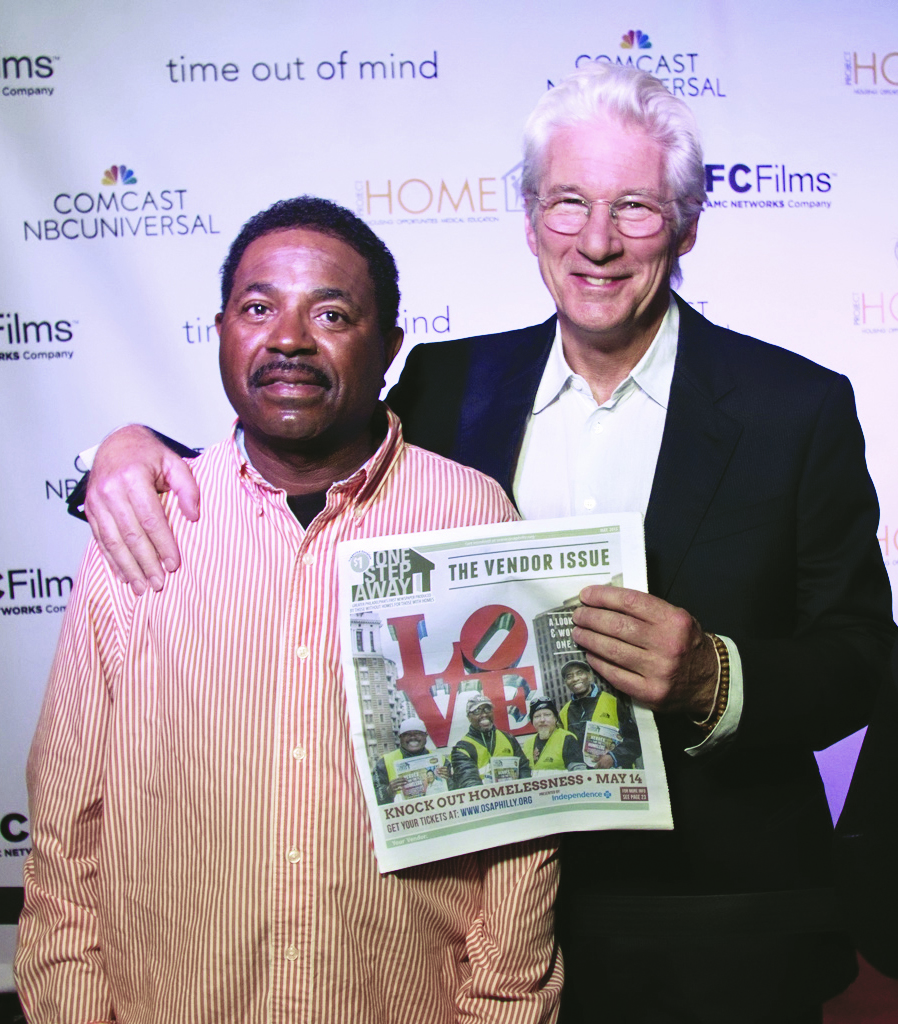
Jerry Tucker (One Step Away) and Richard Gere
“Yeah I have a story I can write,” Jerry said. Gere then pointed to the copy of One Step Away in Jerry’s hand. “And now you have a venue for it that you can put it in.”
Gere also spoke of his passion for his latest project, Time Out of Mind, in which he plays a man struggling to pull himself out of homelessness and reconnect with his estranged daughter.
“We took a lot of care and concern and I think the best parts of ourselves when we made this film,” he said. “I am deeply, deeply proud of this film. I think we told a story that honors the people who’ve been living on the street-for whatever reason, and there’s not just one reason, there are a myriad of reasons how someone could lose it that much-and humanize the situation to the point where I think we identify a much deeper level than as a homeless person.”
He added, “I find myself saying this all the time-our deepest yearning is to be in touch with that thing that is precious and magnificent inside of ourselves. But we’re social beings; to be in a community of people who, when they look at us, we know they think we are precious, is deeply important to all of us.”
Gere’s character George seeks refuge at Bellevue Hospital, a Manhattan intake center for homeless men. He strikes up a friendship with a fellow client Dixon, played by Ben Vereen, who helps him try to repair his relationship with his daughter.
“My hope is presenting human beings,” Gere said of how the film’s two central characters are portrayed.
The core of the film is George’s struggle to be noticed, to navigate living on the streets after he’s kicked out of the abandoned building he was squatting in, and to connect with his family. The plot, as director Moverman said, is the state of being homeless.
“There is a core of understanding a character like this, and understanding the dilemma,” Gere said. One Step Away vendors Jerry and Jeff agree the film does a remarkable job of capturing the reality of homelessness.
Jerry can relate all too well to the character of George, after losing his father and then his mother, Jerry faced homelessness for the first time at the age of 16.
“That’s what it’s really like to be homeless. People turn their backs on you. I was homeless because I didn’t have anyone,” he said.
“[Gere] started to feel how it feels to really be homeless, to go in those shelters, how they treat you in there, he saw all of that.”
“With the camera that far away, there was a certain freedom that I felt,” adds Gere. “But being immersed in the reality of New York – I was invisible in New York. Because I was this character, people decided within two blocks of seeing me that I was a homeless guy, and didn’t look any further. This guy you’re talking to right now is the same guy who was on the street then – and no one made any eye contact.”
Gere often talks about that phenomenon when he discusses making Time Out of Mind. But the concept is a curiosity for most interviewers who talk with him. It’s another example of the kind of human disconnect that is dehumanizing and devastating for people experiencing homelessness.
“People look down on you when you’re homeless,” said Jerry. “In their minds they’re saying, ‘If he can’t help himself, why should we help him?’ That’s what they’re thinking, that’s what they’re looking at.”
For Gere, even though his experience was temporary, being ignored on the street moved him in ways he says are hard to describe.
“It was confusing, and profound,” he said. “As a filmmaker, I was very happy, because it meant we could make the movie. If everyone had recognized me, we would have had to shut down. We couldn’t make the movie; it would’ve been impossible.”
“Now, if Richard Gere, who has money and fame, and in this situation everyone thinks kindly about me, if I can stand on a street corner and be treated like garbage? That’s a profound lesson for me personally, but I think for an audience it should be as well.
“It radically changed my view of myself and of the social fabric around me.”
“Reduced to that without a social structure.”
The film excels in capturing the physical state and destruction of homelessness, but Gere accurately shows the larger mental and emotional devastation of finding oneself in the cycle and instability of being homeless.
Homelessness is a much larger issue than simply not having a home. This fact is illustrated by George’s struggle throughout the movie. Gere even says that the character is living in an animalistic state where all he can think is ‘I am tired, I am hungry, I need a place to sleep.’ Gere strips himself raw (literally, on occasion) and said he boiled the character of George down to the most base level of existence.
The movie also shows the struggles George encounters while trying to meet his basic needs in his interactions with the homelessness system; a system that often further disenfranchises the very individuals it seeks to help.
“There are no bad guys in this movie,” said Gere. “There are people who behave badly, there are people who are stressed out of their minds and overworked and underprepared to do what they’re doing, caught up in bureaucracy and madness, but we are all of us, deeply, in this together. And I would hope that is what it feels like.”
Audiences can see the exhaustion and the frustration in Gere’s face throughout the movie. In one scene he’s asking for a bed in a homeless shelter, the caseworker first makes him answer a litany of questions even though he’s plainly exhausted and just wants to rest.
When he’s asked, “Are you addicted to any substances?” George cries out: “I’m addicted to sleep! I just want to sleep!” Throughout the movie, George is unable to obtain identification without his birth certificate, and can’t get his birth certificate without identification; a theme that demonstrates a frustrating dilemma that many people face.
“It reminds me what I went through, that’s how it is,” said Jerry, “It took a lot on me when he was trying to get the help and they kept asking for all this paperwork that he didn’t have, birth certificate, ID. He didn’t have it. All he kept saying was that he was homeless, he didn’t have anything. And she was still asking for something; he didn’t have anything. And he was trying to get help, but it was hard for him to get the help.”
“A community situation changes lives.”
That “emotional dislocation,” as Gere called it, certainly informed his performance. But the actor’s dedication to the cause informs a larger discussion about the strategies and solutions around homelessness.
Too often we are given an overarching strategy to solving homelessness, but as Gere says, it is not that simple.
“You’ll see in the movie there are all kinds of people in the shelter. It’s not one size fits all. And we have to have strategies that fit all kinds of different people,” he said.
“That’s what families do. It’s not one approach-it’s this person needs that, that person has this problem, we share that part of ourselves with that person. It is this family, a community, that changes lives.”
Of the current shelter system, Gere said “It’s warehousing. Chronic warehousing.”
Jerry agreed, “I remember when I was in the shelter, they slept us eight in a room, like in the movie. There was no breathing room. It wasn’t a good situation, and if you stayed in the shelter, you got stuck. That’s why I became a One Step Away vendor. No good happens in the shelters, only bad.”
Time Out of Mind ends on a hopeful note for Gere’s character George. In real life, people like Jerry are an example that homelessness is a situation people can lift themselves out of, no matter how hard the struggle.
For those who are currently experiencing homelessness, Jerry has this advice: “If I can do it, you can too. There’s always a chance for you to make it if you want.”
Courtesy of INSP News Service http://www.INSP.ngo / One Step Away